
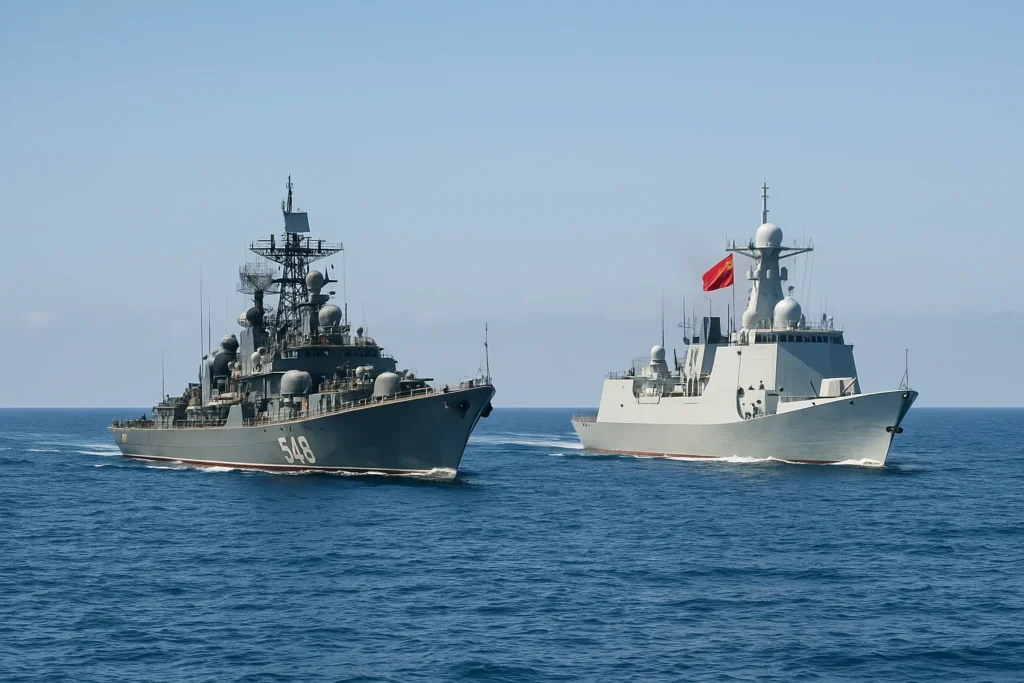
When I first heard about the Russia China joint naval Pacific patrol, my first reaction was basically, “Wow, things are getting interesting out there.” It wasn’t just another military drill. In August 2025, Russia and China sent warships and submarines on a long patrol across the Pacific, carried out joint anti-submarine drills, and showed that their navies can operate far from home together, not just near their own coasts.
Here’s the thing. On paper it looks like a normal part of “russia and china launch joint military drills,” but the details matter. This patrol included their first-ever joint submarine patrol in the Asia-Pacific, plus a route of more than 6,000 nautical miles. That moves their cooperation from symbolic to very real. And because it happened in a region where the US, Japan and others are already active, it naturally grabbed attention from people who follow russia news and Asia-Pacific security.
So if you’ve seen headlines and felt a bit lost, don’t worry. Let’s walk through what actually happened, why they did it, how Japan and the US see it, and what it might mean for the future of the Pacific.
Snippet-Ready Definition:
russia china joint naval pacific refers to recent joint patrols and drills where Russian and Chinese warships, and now submarines, operate together across the Pacific to signal growing strategic cooperation and presence in the region.
Quick Guide Table: Russia–China Joint Naval Pacific Patrol At a Glance
| Aspect | Simple Explanation |
| What happened | Russia and China sent warships and submarines on a long joint patrol in the Pacific, practicing anti-submarine and air-defense drills over thousands of nautical miles. |
| Why it matters | It shows deeper china-russia military cooperation and blue-water capability, adding pressure and complexity for the US, Japan and other Pacific navies. |
| Where it took place | In and around the Pacific Ocean, including areas linked to earlier drills near Japan and routes watched closely by regional powers. |
| Who is watching | The US Navy, Japan’s Self-Defense Forces, regional partners, markets, and anyone tracking Asia-Pacific security and russia news. |
Quick Snapshot: Key Facts about the August 2025 Patrol
Route and Distance: Over 6,000 Nautical Miles across the Pacific
The 2025 patrol wasn’t a short coastal cruise. The Russian and Chinese ships sailed a route of more than 6,000 nautical miles across the Pacific. In simple terms, they showed they could go far, stay out for a while, and work together the whole time.
They moved from waters near Russia, into wider parts of the Pacific, and then back, with refuelling and coordination along the way. For navies, distance is a statement. It says, “We can operate as blue-water navies, not just patrol our backyard.” That’s a big part of why analysts connect this patrol to the idea of a shifting Indo-Pacific balance of power.
Who Took Part: Russian and Chinese Ships, Submarines, and Aircraft
On the Russian side, the Russian Pacific Fleet sent key units, including the Admiral Tributs anti-submarine ship and supporting vessels. China’s People’s Liberation Army Navy (PLAN) contributed ships like the Shaoxing destroyer and the Qiandaohu supply ship. Together, they formed a small but capable task group able to sail, refuel and train over a long distance.
The really new element was underwater. For the first time, both sides added submarines to their joint Pacific activity, turning it into a joint submarine patrol Asia-Pacific mission instead of just a surface convoy. Honestly, that’s the part that made many observers sit up and say, “Okay, this is more serious.”
What They Practiced: Anti-Submarine and Air Defense Drills
During the patrol, they didn’t just sail in a straight line. The ships ran anti-submarine warfare (ASW) drills, air-defense practice, and live-fire training. They worked on hunting submarines using ships, helicopters and aircraft together.
These are the kinds of drills that make china joint military exercises feel less like a show and more like preparation. On top of that, anti-submarine operations are complex, so doing them together suggests a growing level of trust and coordination in china-russia military cooperation.
From Exercises to Blue-Water Patrols: How China-Russia Military Cooperation Evolved
Earlier Joint Sea Drills and Patrols near Japan and Alaska
This 2025 patrol didn’t come out of nowhere. For several years, we’ve seen China and Russia plan joint military exercises in the Pacific near Japan, conduct drills in the Sea of Japan, and even fly joint bomber patrols near Japan and close to the Alaska Air Defense Identification Zone.
If you’ve casually followed these stories, you might remember headlines about Chinese and Russian warships sailing near Japanese islands, or Russian and Chinese bombers flying together near Alaska. All of that built the pattern: more frequent, more coordinated activity, often described as china russia joint naval activity japan in news summaries.
Deepening China-Russia Military Cooperation Over Time
Step by step, this has turned into something deeper. At first it was limited drills, then regular exercises like Joint Sea and Maritime Interaction, and now long-range patrols with submarines included.
From a political angle, it fits the idea of a “strategic partnership without limits” between Moscow and Beijing. From a practical angle, it means their officers, crews and planners are getting used to working side-by-side. When you hear phrases like china and russia unite in commentary, this is often what people are talking about: not just talk, but ships and planes moving together in real time.
Joint Sea 2025 and Maritime Interaction 2025: The Build-Up near Japan
Before the big Pacific leg, Russian and Chinese forces took part in exercises often described as Joint Sea 2025 and Maritime Interaction 2025 near Russia’s Vladivostok and waters close to Japan. Think of this as the “warm-up round.”
In these drills, they practiced things like submarine rescue, coordinated maneuvers, live-fire gunnery and missile defense. For Japan, seeing large ships and aircraft from both countries training nearby is understandably worrying. For Russia and China, it’s a chance to send a message that they’re comfortable operating near US and Japanese interests.
After this build-up phase, part of the group pushed out into the wider Pacific. That’s when the story stopped being just about Japan’s backyard and turned into a broader russia china joint naval pacific patrol.
First-Ever Joint Submarine Patrol in the Asia-Pacific: Why It’s a Big Step
Submarines are different from surface ships. They’re stealthy, they rely on sensitive data, and they’re central to deterrence. So when Russia and China conduct a joint submarine patrol Asia-Pacific, it shows a new level of trust.
They’re not just showing the flag; they’re practicing how to hide, listen and possibly track other submarines together. That’s why analysts say this step raises the bar for regional anti-submarine warfare drills (ASW drills) by Japan, the US and others.
When I read about this, it felt like the relationship moved from “friends doing joint sea shows” to “partners training secretly underwater.” That’s a big symbolic leap in china-russia military cooperation.
Strategic Motives: Why China and Russia Unite at Sea
So why are they doing this? Officially, both sides say these are routine activities meant to “protect maritime security” and “strengthen cooperation,” not to target any third country. You’ll see that line repeated a lot in official statements.
But if you step back, it’s hard not to see the bigger picture. Both countries have tense relations with the US and its allies. A joint patrol of this scale sends a message: they can challenge US and allied dominance at sea, or at least complicate planning. Honestly, it feels like both countries are trying to show their presence in the region and say, “We’re here too.”
In the wider conversation about a multipolar world order, this is one of the practical ways they try to back that idea: coordinating at sea, in the air and, increasingly, underwater.
Regional Reactions: Japan’s View of China-Russia Joint Naval Activity near Its Waters
Japan sees all of this from a very different angle. When china russia joint naval activity japan makes the news, it’s usually described by officials as a “serious concern” or even a potential threat to national security.
From Tokyo’s point of view, having Russian and Chinese ships and aircraft repeatedly circle near Japanese islands looks like a show of force. That’s especially true when exercises happen near disputed or sensitive areas. It’s one reason Japan has been boosting its own defense budget and tightening ties with the US and partners like Australia.
So while Russia and China frame these drills as cooperative and defensive, Japan tends to see them as pressure. That tension is a big part of the story behind the russia china joint naval pacific patrol.
Western Lens: How the United States and Allies Interpret the Patrol
The US and its allies view this patrol as another data point in a long list of china joint military exercises and Russia-China drills. It doesn’t mean a war is starting, but it does mean planners in Washington, Honolulu and elsewhere have to factor in joint Russian–Chinese forces much more seriously.
In response, you’ll often see expanded US and allied exercises in the region: carrier groups in the Western Pacific, joint drills with Japan, South Korea and the Philippines, and even more complex air and missile defense scenarios. It becomes a sort of signalling back and forth at sea.
Some analysts also link this pattern to other tools of influence: cyber, economic pressure and information campaigns. So when you see the patrol discussed in US-focused outlets, it’s usually framed as part of a wider competition in the Indo-Pacific, not a one-off event.
Risks and “Stormy” Encounters: Escalation Concerns in a Crowded Pacific
Here’s the worrying part. The more ships, submarines and aircraft you pack into the same region, the higher the risk of misunderstandings. All it takes is one misread maneuver or one pilot getting too close for comfort, and you’ve got an incident.
We’ve already seen reports of “near misses” between military aircraft, and ships sailing close enough to raise eyebrows. It doesn’t mean a conflict is guaranteed, but it does mean the sea can feel like a storm building in slow motion. The word “storm” shows up in a lot of commentary for a reason.
That’s why people keep talking about rules of behavior at sea and in the air, and about hotlines between militaries. If things go wrong in a russia china joint naval pacific scenario, there needs to be a way to calm it down fast.
Beyond the Headlines: Markets, Technology and Media Narratives
If you’ve ever checked the Dow Jones Industrial Average on the same day as a big military headline, you might notice a small dip or spike. Markets don’t move only because of drills, of course, but investors do pay attention to tensions in major trade routes. The Pacific is one of those routes.
Media coverage can also color how we feel. Some outlets push dramatic language, others take a calm, analytical tone. The truth usually sits somewhere in between. The key is to look for clear facts: who, where, when, what kind of ships.
Meanwhile, China is working on long-term projects like the Experimental Advanced Superconducting Tokamak fusion experiment. It’s not directly linked to naval drills, but it shows how technology, energy, economics and security all live in the same big story. The world isn’t just about missiles and stealth aircraft; it’s also about who leads in science and industry.
How to Follow Russia China Joint Naval Activity like an Informed Observer
If you want to follow this stuff without getting overwhelmed, here are a few simple tips that help me:
- Check multiple sources: Russian, Chinese, Japanese, US and independent outlets. Each has its own angle.
- Look for maps and distances: Seeing where the ships actually are makes the story much clearer.
- Notice patterns, not just one event: the value is in seeing how drills like joint sea 2025 repeat or evolve.
Guess what: once you look at it this way, the news feels less like random “naval drama” and more like a long, slow chess game.
Looking Ahead: What Future Joint Sea Drills and Pacific Patrols Could Look Like
Most experts think we’ll see more of these joint activities, not fewer. Future patrols may bring more complex coordination, maybe more advanced ships, and possibly more integrated air and sea operations.
We might also see other countries adjust their own exercises in response. That could mean more US-Japan-Australia drills, more focus on anti-submarine skills, and stronger partnerships with Southeast Asian states.
The best part is, from a reader’s point of view, you don’t need to be a military specialist. If you just pay attention to who’s sailing where, how often they do it, and how neighbors react, you’ll understand the core of what’s happening.
Conclusion: The Russia China Joint Naval Pacific Patrol in a New Security Era
So, what does the russia china joint naval pacific patrol really tell us? First, it shows that china-russia military cooperation has moved well beyond symbolic drills. They’re now comfortable sending ships and submarines together across long distances, in a region filled with US and allied forces.
Second, it reminds us that Japan, the US and other countries are carefully watching and adjusting. Nobody wants a crisis, but nobody wants to look weak either. That’s why you see more exercises on all sides, more statements, and more analysis.
When I look at it all, I don’t see an immediate disaster, but I do see a more crowded, competitive Pacific. If you stay curious, avoid sensationalism, and keep an eye on patterns, you’ll be able to read the next headline about Russia and China at sea and think, “Okay, I get what’s going on here now.”
FAQs for “russia china joint naval pacific”
1. Can the US Navy beat the Chinese navy?
There’s no simple yes or no. The US Navy still has more global blue-water experience, alliances and carrier groups, while China’s navy is growing fast in size and technology. Any real conflict would depend on many factors (location, allies, strategy), and most experts stress that the goal should be avoiding open war, not “beating” one side or the other.
2. Are Russian and Chinese warships in the Pacific?
Yes. Russian and Chinese warships regularly operate in the Pacific, and recent russia china joint naval pacific patrols have included long-range missions with surface ships and submarines. These activities are often part of joint sea drills and signal both countries’ interest in being seen as major Pacific players.
3. What is the joint naval drill between China and Russia?
The joint naval drills are a series of exercises where Russian and Chinese navies train together. They’ve used names like Joint Sea and have included anti-submarine warfare, air defense, and coordinated sailing. The recent patrols in the Pacific take those drills a step further by adding long distances and joint submarine activity.
4. Do Russia and China have a military alliance?
They don’t have a formal mutual-defense treaty like NATO members do, so technically they’re not official treaty allies. Instead, they describe their relationship as a “strategic partnership” and show it through things like joint military exercises, naval patrols and political coordination on big global issues.
Disclaimer
This article is for informational and educational purposes only. It does not provide political advice, military guidance, or any form of professional recommendation. All details about the Russia China joint naval Pacific patrol are based on publicly available reports at the time of writing and may change as new information becomes available. Readers are encouraged to verify important facts through trusted and official sources before drawing conclusions.