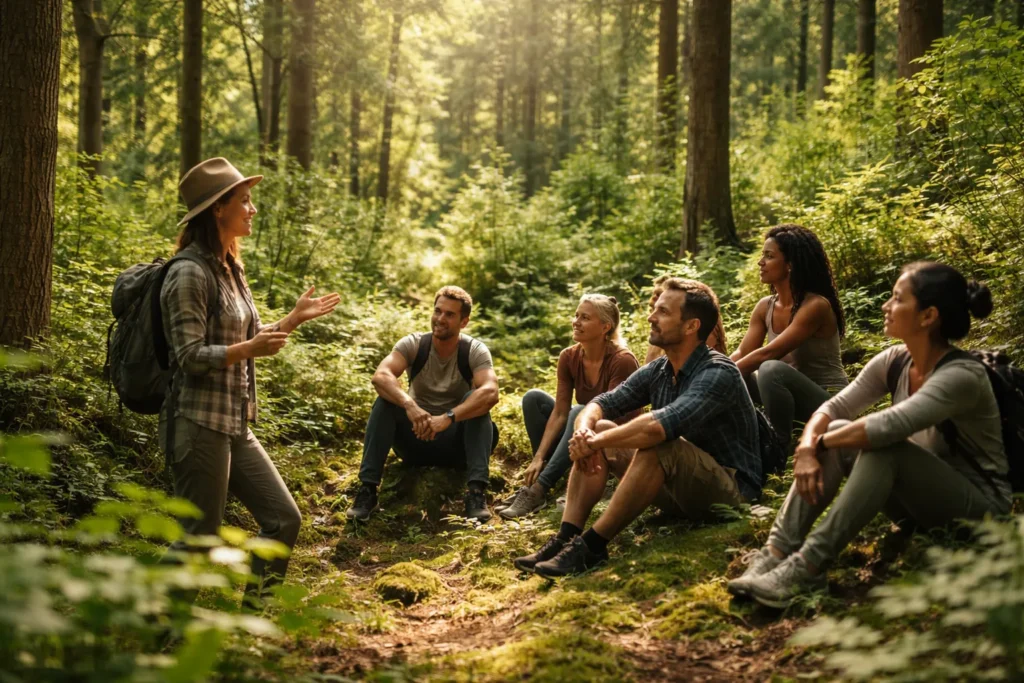
If you’ve ever felt your shoulders drop the moment you step under tree cover, you already understand the basic idea of forest bathing. It isn’t a workout, and it doesn’t require special gear. It’s a slow, intentional way of being in a forest (or any richly natural place) that helps your nervous system downshift—by letting your senses lead, rather than your to-do list.
Unlike a typical walk where you’re trying to “get somewhere,” forest bathing is about arriving—again and again—in small moments: the smell of damp soil, the texture of bark, the hush of wind moving through leaves. Many people describe it as surprisingly practical: a gentle reset that’s easy to fit into real life.
What Forest Bathing Is (And What It Isn’t)
Forest bathing is a nature-based well-being practice that focuses on immersing in the atmosphere of a forest with conscious awareness—seeing, listening, touching, and breathing the environment in a calm, receptive way.
What it is:
- A slow sensory experience in nature
- A mindful “presence” practice (without needing to meditate perfectly)
- Often done in a small group or one-to-one with a guide
What it isn’t:
- Hiking for distance or speed
- Survival training or wilderness skills
- A replacement for medical care (though it can complement healthy routines)
Why It Can Feel So Restorative
Most of us spend our days in high-stimulation environments—screens, traffic, notifications, fast decisions. A forest offers the opposite: rich sensory input that is soft, patterned, and non-demanding. That’s a big reason people feel calmer quickly.
Reported and researched benefits commonly associated with forest bathing include:
- Lower stress and improved mood (often linked with reduced cortisol in studies)
- Support for immune function, often discussed in relation to phytoncides (natural compounds released by trees) and natural killer (NK) cell activity
- Clearer thinking and attention, especially after time away from urban noise and constant inputs
Even if you don’t track biomarkers, the real-life version of these benefits is simple: people tend to sleep better, feel less “wired,” and find it easier to breathe deeply and think clearly.
How to Try Forest Bathing on Your Own (A Beginner-Friendly Method)
You can practice forest bathing without any special training. Here’s a simple structure that works well for first-timers:
1) Choose the right place
A forest is ideal, but any natural space can work:
- A wooded park
- A riverside trail with trees
- A botanical garden
- Even a quiet neighborhood with mature tree cover
Pick somewhere you can move slowly without feeling rushed.
2) Slow down on purpose
This is the hardest part for many people. Try walking at half your normal pace for the first 10 minutes. Let your body set the rhythm, not your brain.
3) Use the “five senses” approach
Spend 2–3 minutes on each sense:
- Sight: Look for small details—moss, leaf shapes, shifting light
- Hearing: Layered sounds (birds, wind, distant water)
- Smell: Soil, pine, rain, flowers
- Touch: Bark texture, leaf surface, cool air on skin
- Taste: Even without eating, notice the “taste” of air (humid, crisp, earthy)
4) Add one “still” moment
Sit or stand quietly for 5–10 minutes. This is where people often notice the deepest calm. No need to force anything—just allow.
5) Close with a gentle reflection
Ask yourself:
- What felt easiest to notice today?
- What changed in my body (breath, shoulders, jaw, mood)?
- What do I want to bring back into my day?
Safety and Comfort Tips (So It Actually Feels Good)
Forest bathing should feel supportive, not stressful. A few practical tips help a lot:
- Dress for stillness: You may feel cooler when moving slowly. Bring a light layer.
- Mind the footing: Slow walking is great—just watch roots and uneven ground.
- Leave no trace: Keep it simple, respect wildlife, stay on paths where appropriate.
- Know your limits: If you have allergies, mobility concerns, or health conditions, plan accordingly and consider guided sessions.
The Role of a Forest Therapy Guide: Why Guidance Changes the Experience
A skilled guide doesn’t “lecture” you through the woods. Their real value is how they shape the experience.
A guide typically helps by:
- Creating a safe pace (so the group doesn’t unconsciously speed up)
- Offering simple invitations that deepen sensory awareness
- Supporting social ease in a group (without forcing sharing)
- Choosing a suitable route, timing, and “rest spots”
- Holding a calm structure so participants can relax into the experience
In other words, a guide makes the experience easier to drop into—especially for people who struggle to slow down, feel anxious outdoors, or are new to mindfulness.
When It’s Worth Going With a Certified Professional
If you’re curious about forest bathing, self-guided sessions are a great start. But there are times when professional guidance really helps:
- You want a more therapeutic, structured experience
- You’re planning sessions for a community group, workplace, or retreat
- You support others (coaching, wellness, education, healthcare) and want to integrate nature-based practice responsibly
- You want to guide sessions yourself and need a credible training pathway
That’s where working with a certified forest therapy guide becomes especially relevant—because guiding is not just “loving nature.” It’s facilitation, safety, sequencing, group dynamics, and ethics.
What Professional Training Often Covers (Beyond “Take a Walk in the Woods”)
Quality training programs generally combine theory with practice, so guides understand both what to do and why it works.
Based on the program details provided for forest therapy practitioner training, the learning format can include:
- Flexible scheduling (no fixed start/end dates), so learners can shape a calendar around real-life responsibilities
- Access over a multi-month window (for example, 36 weeks of course access is described)
- A structured curriculum that blends theoretical content with practical experiences, distributed across multiple modules (the program page describes 14 modules)
- Strong grounding in research, including an extensive bibliography (the page describes 340+ references and scientific articles)
- A pathway that can lead to more than one certificate (a “double certificate” is explicitly described)
For someone who wants to guide others responsibly, this kind of structure matters. It moves the work from “I like nature” to “I can hold a safe, effective experience for different people.”
How to Choose the Right Guide (or Training Path) for You
If you’re hiring a guide, look for clarity in these areas:
1) Approach and pacing
Do they describe what a session feels like? Do they emphasize slow, sensory presence rather than fitness?
2) Safety and accessibility
Can they adapt for:
- different mobility levels
- nervous system sensitivity/anxiety
- weather changes
- group needs (quiet vs. social)
3) Ethics and boundaries
A professional guide should be clear about what they do—and what they don’t do (especially around medical or psychological claims).
4) Training credibility
Ask:
- What training did you complete?
- Do you have a structured method for session flow?
- How do you handle group dynamics?
If you’re considering training for yourself, choose a program that matches your goals:
- Guiding wellness sessions (community, retreats, workplaces)
- Supporting vulnerable populations (requires stronger training and clear boundaries)
- Integrating nature with an existing profession (coaching, education, health)
A Simple Way to Start This Week
If you want to begin today (without overthinking it), try this:
- Pick a green space with trees.
- Set a 45-minute window.
- Walk slowly for 10 minutes.
- Sit for 10 minutes.
- Walk slowly again for 10 minutes.
- Spend the last 5 minutes noticing your breath and posture.
Do it once, then decide what you want next: a repeat solo practice, a guided experience, or training for deeper skill.
Final Thoughts
Forest bathing is one of the rare wellness practices that is both simple and profound. You don’t need expensive equipment or perfect technique—just time, attention, and a living landscape. And when you’re ready to go deeper, a well-trained guide can turn a pleasant walk into a carefully held experience that supports calm, connection, and real restoration.
If you want, I can also format this into a “guest post” style (with a short intro, author bio placeholder, and cleaner transitions) while keeping the same two links and word count.

Hi, I’m Bilal, the founder of outofmagazine.com. I love sharing fresh ideas, stories, and helpful insights on all kinds of topics that spark curiosity. My goal with this site is simple—to create a space where readers can find inspiration, useful tips, and engaging reads on lifestyle, trends, and everything in between.