
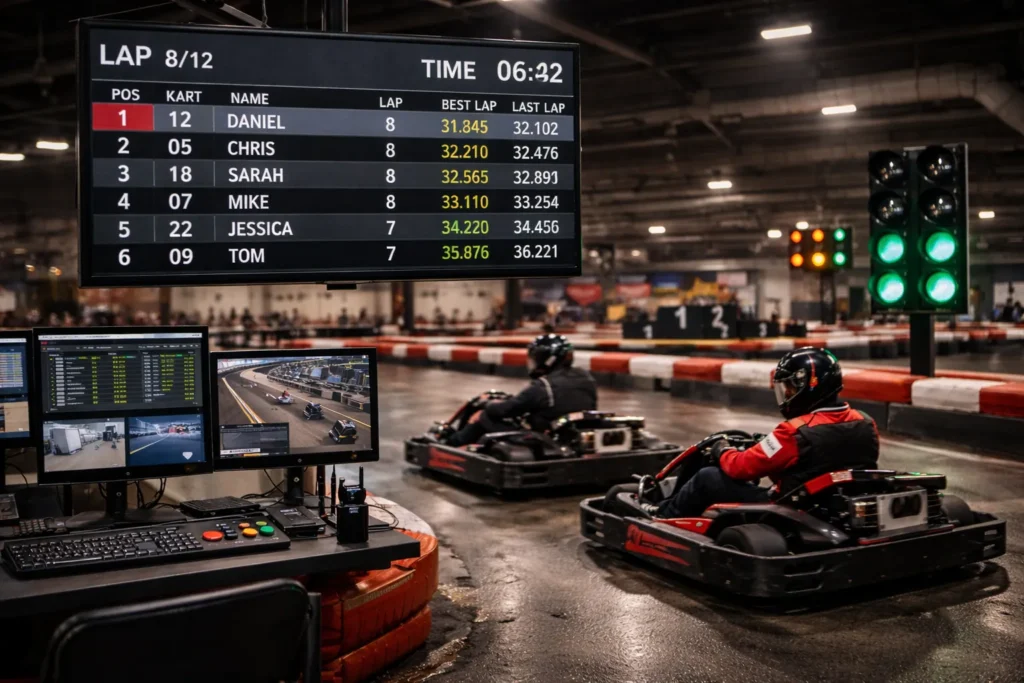
If you run or plan to build a modern kart facility, your technology stack matters just as much as your track layout. From lap timing and race control to customer flow and on-site visuals, the right systems turn a “fun ride” into a smooth, professional motorsport experience. One of the easiest upgrades guests notice immediately is electronic scoreboards—because the moment results are visible, the competition feels real, the energy rises, and the venue looks more premium.
But a scoreboard is only one piece of the bigger picture. Today’s successful kart facilities combine software and electronics into a connected ecosystem: timing + race management + center operations + installation and support. When these parts are built to work together, you get faster race cycles, fewer disputes, better staff control, and a guest experience that feels organized and exciting from check-in to podium photos.
Below is a practical, informational guide to what “complete software and electronics solutions” really means for karting and motorsport—and how to choose systems that scale with your business.
1) Why technology is the backbone of a successful kart venue
Karting centers usually grow in complexity over time. What starts as a simple timing setup quickly expands into:
-
More karts and more frequent sessions
-
Multiple race formats (arrive-and-drive, leagues, corporate events, endurance)
-
Busy weekend traffic with long queues
-
Customer expectations for fast, clear results and fair racing
-
Staff needing better control tools and fewer manual steps
Without integrated systems, operators end up juggling different platforms, manual paperwork, and “workarounds.” That leads to slow check-ins, delays between races, confusion about results, and customer frustration—especially when a race is close and people want immediate confirmation.
A connected approach solves that: the track becomes easier to run, and customers feel like they’re racing at a real motorsport venue.
2) The role of electronic scoreboards in the guest experience
Timing results can live on a monitor behind the counter, but that doesn’t create atmosphere. A properly designed scoreboard acts like the “stadium screen” of the track.
What scoreboards do best:
-
Display live race positions and lap times in a way people understand quickly
-
Reduce disputes (everyone can see the same information)
-
Increase engagement for spectators and waiting groups
-
Create a premium look and “event feel”
-
Encourage repeat racing (“I can beat that time!”)
Where scoreboards have the biggest impact:
-
Busy venues with multiple groups queued
-
Corporate events where teams want visibility
-
League nights and championships
-
Family centers where spectators watch from lounges
-
Tracks with viewing areas near the finish or pit lane
The key point: a scoreboard should not be an isolated screen. It works best when it’s connected to timing and race management so data updates instantly, reliably, and in a consistent format.
3) Timing systems: accuracy, reliability, and fairness
Lap timing is the heartbeat of karting. A strong timing setup must be consistent in high-traffic conditions, resistant to interference, and easy for staff to manage during back-to-back races.
Features that matter in real operations:
-
Fast detection and accurate lap capture
-
Stable performance during peak hours
-
Clear handling of out-laps/in-laps and session rules
-
Easy correction workflows (when needed) without chaos
-
Support for different race modes (practice, qualifying, finals, endurance)
Reliability matters because timing issues directly impact trust. If the system “feels wrong,” customers assume the race was unfair—even if it was a simple operational mistake. Good systems reduce both technical errors and human errors.
4) Race management software: turning raw timing into a real event
Race management is what transforms lap times into a structured competition. It’s the difference between “drive for fun” and “organized racing.”
A robust race management platform helps with:
-
Creating sessions quickly (especially for walk-ins)
-
Automatically assigning grids, heats, and finals
-
Managing penalties, flags, and race control decisions
-
Running multi-round formats and league scoring
-
Displaying results clearly and consistently
This is especially important for venues that host events. Corporate customers often expect an “F1-style experience” with qualifying, grids, and finals. If you can deliver that smoothly, your venue becomes the obvious choice for repeat bookings.
5) Center operations: check-in speed and customer flow
Many tracks lose money not because the racing is bad—but because operations are slow. A great track can still struggle if staff spend too much time fixing bookings, managing queues, or manually organizing races.
Modern center operations systems can streamline:
-
Customer registration and waiver workflows
-
Session scheduling and queue management
-
Group management for parties and corporate events
-
Add-ons and upsells (extra races, memberships, league entry)
-
Staff roles and permissions (front desk vs race control)
When operations run smoothly, you fit more races into the day without rushing customers. That means better throughput, fewer complaints, and a more controlled environment for staff.
6) The power of custom systems built for karting and motorsport
Every venue is different. Some tracks focus on high-volume public sessions, while others prioritize leagues and competitive racing. Some are indoor entertainment centers; others are outdoor motorsport facilities.
That’s why custom solutions matter.
Custom systems can help when you need:
-
Unique race formats or scoring models
-
Multiple track layouts or split configurations
-
Special event workflows (team racing, endurance, championships)
-
Integration with your venue’s business processes
-
Hardware layouts designed around your building, sightlines, and safety rules
Instead of forcing your operation to fit generic software, custom systems adapt to your venue—making staff work easier and the customer experience more polished.
7) Manufacturing and installation: why “end-to-end” matters
Buying components from different vendors often leads to finger-pointing when something goes wrong. Timing vendor blames the display vendor, display vendor blames the network, and staff are stuck in the middle on a Saturday night.
End-to-end solutions—covering electronics, software, manufacturing, and installation—reduce those risks because:
-
Hardware and software are designed to work together
-
Installation is planned around the venue’s real layout
-
Cabling, mounting, and protection are handled professionally
-
Testing and configuration happen as part of the project, not after
-
Support becomes clearer because ownership is not fragmented
For a kart track, this matters because downtime is expensive. If your systems fail on a peak weekend, you lose revenue, refunds increase, and your reputation takes a hit.
8) What to look for when choosing a solution provider
When selecting a partner for timing, race management, and electronics, look beyond features. You want a provider that understands karting operations and can support you long-term.
A useful checklist:
-
Proven experience in karting/motorsport environments
-
Ability to deliver both software and electronics as one system
-
Customization options that match your business model
-
Installation support and practical on-site planning
-
Clear troubleshooting and maintenance processes
-
Scalability (more karts, more races, more locations in the future)
Also consider how the system will grow. Many venues start with basic timing, then add scoreboards, then add more advanced race formats, leagues, and corporate event packages. Your tech should scale with that journey.
9) How modern go-kart centers use integrated tech to stand out
A facility doesn’t need to be the biggest to be the most successful. Often, the “best” venue is the one that feels professional, runs on time, and delivers a consistent customer experience.
For go-kart centers, integrated timing and race management plus high-visibility displays create a strong competitive advantage. Customers remember:
-
How fast they got on track
-
Whether results were clear and immediate
-
Whether the event felt organized
-
Whether the venue looked modern and exciting
-
Whether staff were in control and confident
When your systems support your staff, the whole facility feels smoother. That shows up in reviews, repeat visits, party bookings, and league participation.
10) Final thoughts: build a racing experience, not just a track
Track design brings customers in once. A well-run racing experience brings them back.
If you’re upgrading an existing venue or planning a new one, focus on the full ecosystem: timing accuracy, race management structure, operational flow, and guest-facing displays. When these work together, you reduce friction, improve fairness, and create the kind of atmosphere that makes karting feel like real motorsport.
A modern kart facility is not just about speed—it’s about how professionally you deliver the entire race day from start to finish.
Hi, I’m Bilal, the founder of outofmagazine.com. I love sharing fresh ideas, stories, and helpful insights on all kinds of topics that spark curiosity. My goal with this site is simple—to create a space where readers can find inspiration, useful tips, and engaging reads on lifestyle, trends, and everything in between.