
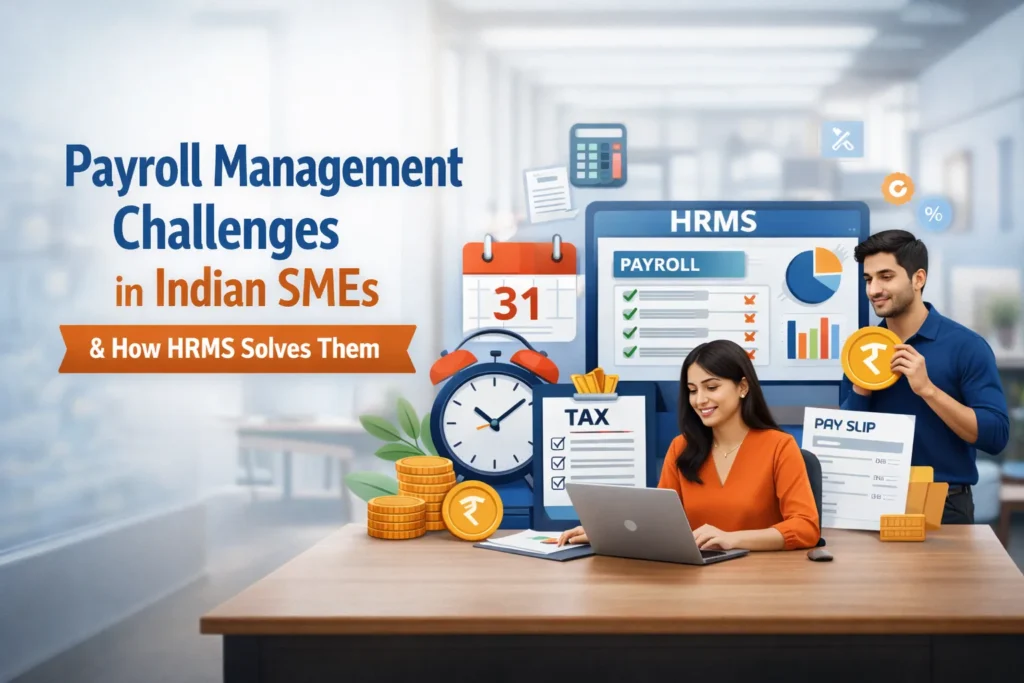
Managing a small or medium-sized business in India has its difficulties, and handling the payroll is one of the biggest problems. Paying wages on time is not the only factor that matters, according to the article; it is about navigating different tax regimes, compliance requirements, and employee expectations while keeping the business running.
For many SME owners, payroll is a monthly struggle. An incorrect calculation, a missed deadline, or a compliance error could result in employee mistrust, legal notices, and, in addition, monetary fines. The good news is that modern HRMS payroll software in India solutions are changing the way companies interact with the challenges, hence businesses move from turmoil to stability.
In this article, we will identify the real payroll management challenges in Indian SMEs, uncover the hidden costs of improper payroll practices, and explain how implementing appropriate technology can be a final solution to these problems.
What Is Payroll Management in Indian SMEs?
Payroll Management Software involves processing labor payments, including calculations and disbursements, in compliance with Indian labor regulations. It also carries the responsibility of handling remuneration components such as the principal wage, HRA, allowances, and deductions like PF, ESI, PT, and TDS. Add bonus computation, gratuity, and leave encashment, and you will face a multifaceted financial challenge.
For SMEs, the issue is even more serious. Large enterprises with dedicated payroll teams and costly software at their disposal are quite different from small-scale businesses, which are mostly dependent on spreadsheets, manual calculations, and some form of outsourcing. The Indian payroll process is increasingly susceptible to errors and time-consuming when a business owner must wear multiple hats.
Major Payroll Management Challenges Faced by Indian SMEs
Multiple Statutory Compliance Requirements
India’s labor laws and regulations governing payroll are often considered an ocean without a shore due to their complexity. SMEs must ensure compliance with PF, ESI, PT, TDS, LWF, the Bonus Act, and Gratuity, with each aspect having its own set of deadlines and documentation requirements. The problem does not end there, as laws vary by state, and what is valid in Maharashtra may not apply in Karnataka. Thus, manually keeping up with these compliance requirements is certainly a recipe for Indian payroll compliance nightmares.
Manual Payroll Processing & Human Errors
Many SMEs still process payroll using Excel spreadsheets. In such cases, errors due to formulas, duplicate employee records, and erroneous calculations are common. If a single incorrect cell reference results in employees being underpaid or overpaid, it erodes trust and creates unnecessary problems. Payroll errors in SMEs aren’t just inconvenient—they’re costly.
Salary Delays & Payroll Disputes
If a business decides to handle payroll manually, then delays will always be around the corner. Employees become frustrated with delayed salary processing and incorrect payslips, which erodes their trust in management. In a competitive talent market, skilled workers won’t think twice before quitting if they are feeling undervalued or mistreated.
Attendance, Leave & Overtime Mismanagement
Whether using registers or basic systems, manual attendance tracking leads to discrepancies. Incorrectly deducted leave and inaccurately calculated overtime pay are common payroll issues in small businesses. The mistakes keep piling over time, turning into disputes and hatred.
Frequent Tax & Labor Law Updates
India continues to change its tax and labor laws. Businesses must stay up to date on budget announcements, new tax regimes, compliance policy changes, and related developments. In the absence of a dedicated HR team, SMEs will struggle to keep up with these changes.
Payroll Data Security Risks
Details on the earnings of an individual are highly confidential. Nonetheless, many SMEs store payroll information in publicly accessible spreadsheets or shared drives, which exposes them to the risk of data leaks or unauthorized access. Poor access control jeopardizes employee privacy and the business’s reputation.
Scalability Issues as Teams Grow
When your company grows from 10 to 50 employees, and later to 100, a manual payroll system will no longer be functional. The task will be chaotic, and the HR department will have only enough staff to handle it, which will lead to burnout and errors.
Hidden Business Costs of Poor Payroll Management
- Poor payroll management affects more than just cash flow — it creates long-term operational problems.
- Compliance penalties and legal notices can arise, draining both finances and organisational resources.
- HR teams face increased manual workload, leaving less time for planning and strategic tasks.
- Employee dissatisfaction grows, leading to higher attrition and increased recruitment costs.
- The risk of audits rises significantly when payroll records are incomplete or inaccurate.
And perhaps most damaging, your employer brand suffers when word spreads about payroll management challenges in Indian SMEs.
Learn more about third-party payroll services for SMEs and how they simplify payroll compliance and cost management.
What Is HRMS Payroll Software?
An HRMS for payroll management is an integrated platform that automates salary calculations, compliance reporting, and payroll processing. It also enables an organization to integrate modules such as leave management and attendance tracking. Therefore, an organization can become a single ecosystem, with data moving freely across departments. The benefits are obvious – no hand calculation and no reconciliation woes.
How HRMS Solves Payroll Challenges for Indian SMEs?
Automated Salary Calculations
Payroll automation for SMEs eliminates manual calculations. The system automatically calculates salaries, deductions, reimbursements, and net pay in accordance with the defined rules. What took several hours is now completed in a few minutes.
Built-In Statutory Compliance
Modern HRMS payroll software India platforms have built-in compliance for PF, ESI, PT, and TDS. They generate auto challans, compliance reports, and Form 16; thus, users are never late for deadlines or face fines.
Real-Time Attendance & Leave Integration
The use of biometric and mobile attendance systems has enabled real-time synchronization with payroll. Leave deductions are processed automatically, and overtime is calculated accurately. As a result, there is no manual cross-checking between different systems.
Tax Management & Payslip Automation
The HRMS software calculates an employee’s income tax accurately, whether they choose the old or new tax regime. Digital pay slips are printed on the spot and sent via email or through employee self-service portals.
Error-Free Payroll Processing
Through automated validation and minimal manual effort, payroll errors in SMEs have been eliminated. The discrepancies that occur are flagged by the system before the payroll is processed, thus ensuring accuracy every single time.
Strong Data Security & Access Control
The security of sensitive payroll data is ensured by cloud encryption and role-based access control. Access to the salary information is only granted to persons authorized to view or modify it, thus significantly reducing the security risks.
Scalable Payroll Management
The SME payroll solutions can be scaled easily, whether the business employs 10 or 1,000 people. As your company expands, the system will grow with you; there will be no need to switch platforms or undertake a complete overhaul of your processes.
Key Features to Look for in HRMS Payroll Software for SMEs
When evaluating salary processing software India, you should look at the following features:
- End-to-end payroll automation for faster, error-free processing
- Statutory compliance with EPF, ESI, PT, LWF, and TDS
- Support for both new and old tax regimes
- Multi-location payroll management
- Employee self-service portal for easy access
- Seamless accounting integration
- Automated payroll and compliance reports
- Ideal best payroll software for SMEs
Business Benefits of Using HRMS for Payroll
Faster salary processing means happier employees. Zero compliance risk is like insurance that protects your business from legal troubles. Improved employee satisfaction leads to higher employee retention. Reducing HR workload increases the time your team has to focus on business growth. Cost savings from error- and penalty-free situations accumulate quickly. Lastly, audit-ready payroll records ensure you are always prepared for inspections.
Industries That Benefit Most from HRMS Payroll Software
Startups trying to manage their growth and stay compliant, manufacturing SMEs handling shift workers, IT, and SaaS companies with remote teams, retail and distribution businesses having multiple branches, and staffing and recruitment firms experiencing high employee turnover—all these industries can derive great value from payroll automation for SMEs.
Which HRMS Payroll Software in India should you pick?
Focus on cloud or on-premise deployment when making your choice. Examine pricing and ROI, ensure compliance with the law, identify ways to integrate it with existing tools, test customer support quality, and assess data security standards. Making the right choice will turn the payroll task from a headache into a strategic advantage.
Payroll Before & After HRMS – A Real Transformation
Without HRMS: Processing a salary manually, constant payroll errors, continuous stress due to compliance issues, frustrated employees, and loss of control of the situation by the HR teams.
With HRMS: Payroll is automated, calculation errors do not occur, salary is in legal compliance, employees trust the business more, and the HR professionals can focus on their business operations.
Conclusion
Payroll management challenges in Indian SMEs do exist, but they can be overcome. With the right HRMS payroll software in India – such as WeekMate – businesses can eliminate these problems effectively. You gain better control over payroll accuracy, ensure statutory compliance, save valuable time, and build lasting employee trust. The real question is not whether payroll should be automated, but how soon. In today’s competitive environment, accurate, timely, and compliant payroll processing is no longer a luxury – it’s a necessity.
FAQs
Do Indian SMEs need HRMS payroll software?
Although not a law, HRMS plays a significant role in accuracy, compliance, and operational ease.
Does HRMS automate PF, ESI, PT, and TDS?
Certainly, cutting-edge HRMS platforms do it all – they take care of statutory deductions and also create compliance reports.
Is HRMS superior to payroll outsourcing?
HRMS provides greater control, faster processing, and lower long-term costs than outsourcing.
How much does HRMS payroll software cost in India?
Depending on the features and number of employees, the cost ranges from ₹50 to ₹200 per employee per month.
Does HRMS support multibranch payroll?
Yes. Cloud-based HRMS solutions can efficiently handle payroll across multiple branches.

Hi, I’m Bilal, the founder of outofmagazine.com. I love sharing fresh ideas, stories, and helpful insights on all kinds of topics that spark curiosity. My goal with this site is simple—to create a space where readers can find inspiration, useful tips, and engaging reads on lifestyle, trends, and everything in between.